Your Written Asthma Action Plan: A Complete Guide
A written asthma action plan is a personalized document created with your doctor that tells you exactly what to do based on how you are feeling. It is one of the most powerful tools for managing asthma safely and confidently -- yet studies show that fewer than 30% of people with asthma in the United States currently have one.
A 2019 Cochrane review of 39 randomized controlled trials found that self-management education combined with a written action plan reduced asthma hospitalizations by 50%, ER visits by 38%, and unscheduled doctor visits by 23% compared to usual care.
At Advanced Asthma Clinic in Plantation, FL, Dr. Frank Hull develops personalized asthma action plans for every patient. With over 20 years of pulmonary research experience, Dr. Hull ensures your plan is tailored to your specific asthma type, triggers, and treatment regimen.
What Is a Written Asthma Action Plan?
A written asthma action plan (also called a WAAP or asthma management plan) is a personalized guide -- typically one page -- that outlines (for a full overview of the medications it references, see our asthma medications guide):
- Your daily controller medications and doses
- Your rescue medications and when to use them
- How to recognize worsening symptoms
- When to adjust medications on your own
- When to call your doctor
- When to go to the emergency room
- Your personal triggers and early warning signs
- Emergency contacts and preferred hospital
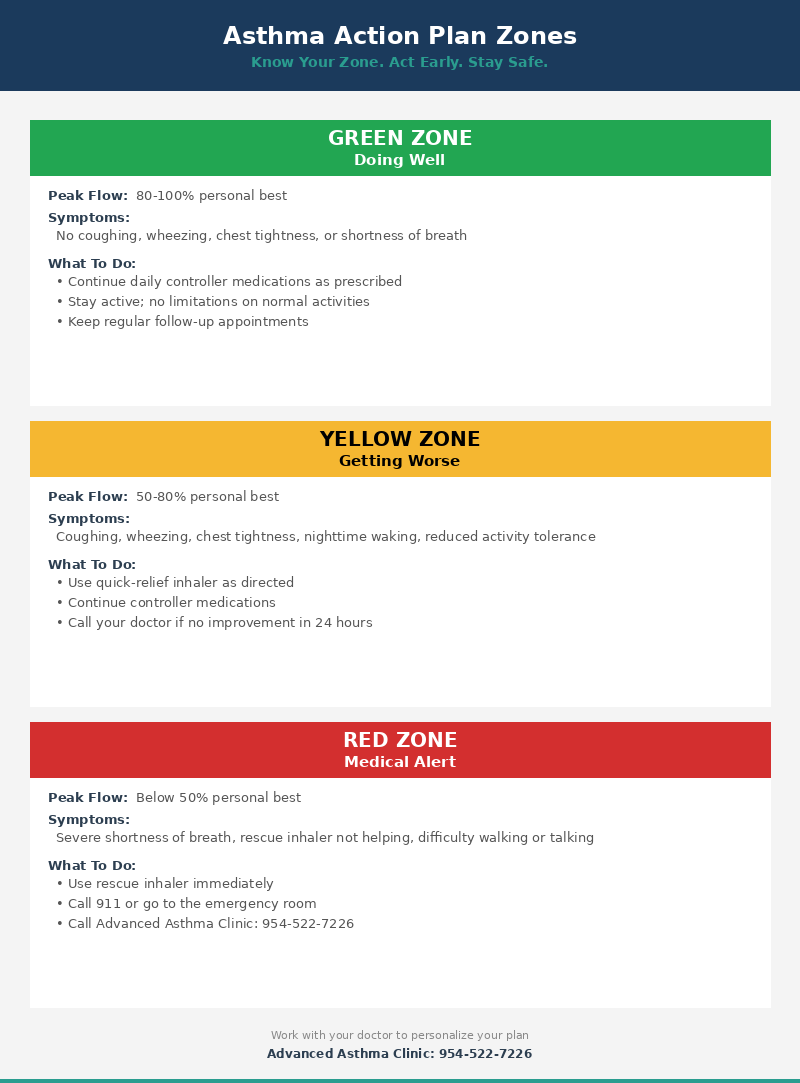
Think of it as a traffic light for your breathing. The plan uses three color-coded zones -- Green, Yellow, and Red -- so you always know where you stand and what action to take next. The National Asthma Education and Prevention Program (NAEPP), Global Initiative for Asthma (GINA), and the American Lung Association all recommend written action plans for every person with asthma, regardless of severity.
Why Written Beats Memory
During a severe asthma attack, cognition is impaired by hypoxia, anxiety, and physical distress. Patients in respiratory distress frequently make critical medication errors when relying on memory alone -- using the wrong dose, missing a step, or delaying calling for help. A laminated or phone-accessible written plan removes the cognitive burden precisely when it matters most.
The Three Zones Explained
Green Zone -- Doing Well
You are in the Green Zone when you:
- Breathe comfortably at rest and during activity
- Sleep through the night without coughing or wheezing
- Can perform daily activities, exercise, and work normally
- Have a peak flow reading at 80-100% of your personal best
Action: Continue your daily controller medications as prescribed. No changes needed. This is where you want to stay.
Yellow Zone -- Caution
You are in the Yellow Zone when you notice:
- Coughing, wheezing, or mild shortness of breath
- Nighttime symptoms waking you up
- Symptoms during or after physical activity beyond your normal pattern
- Needing your rescue inhaler more than twice a week (outside of pre-exercise use)
- A peak flow reading at 50-79% of your personal best
Action: Use your quick-relief inhaler (typically albuterol) as directed (review proper inhaler technique to ensure your rescue medication reaches your airways effectively). Your plan may instruct you to increase your controller medication temporarily -- for example, doubling your inhaled corticosteroid dose. If symptoms do not improve within the timeframe your doctor has specified, call the clinic.
Red Zone -- Medical Alert
You are in the Red Zone when:
- Your rescue inhaler is not helping or relief lasts less than 4 hours
- You cannot speak in full sentences due to breathlessness
- Lips or fingernails appear bluish or gray
- Breathing is very hard, fast, or labored -- ribs may show with each breath
- Peak flow is below 50% of your personal best
Action: Use your rescue inhaler immediately. Call 911 or go to the nearest emergency room. Do not drive yourself. This is a medical emergency. For detailed step-by-step guidance on what to do during an attack, see our asthma emergency management guide. Contact our office at (954) 522-7226 as soon as possible after receiving emergency care.
Peak Flow Monitoring: Your Early Warning System
A peak flow meter is a simple, portable device that measures how fast you can blow air out of your lungs. Daily readings give you an objective number to match against your zones -- often catching changes before you feel symptoms. This is especially valuable for patients with poor symptom perception, a condition common in severe or long-standing asthma where airflow decline is not felt until it becomes significant.
Your personal best peak flow is determined during a period when your asthma is well controlled. Dr. Hull measures this during comprehensive lung function testing at our clinic, then calculates your Green, Yellow, and Red Zone ranges.
How to Use a Peak Flow Meter
- Stand up straight and take a deep breath -- fill your lungs completely
- Place the mouthpiece in your mouth and close your lips tightly around it
- Blow out as hard and fast as you can -- one quick blast
- Record the number. Repeat two more times
- Write down the highest of the three readings
Check your peak flow every morning before taking your medications, and any time you feel symptoms coming on. Tracking trends over time is one of the best ways to detect gradual changes in airway function.
Triggers: Know Yours and Plan Around Them
Your action plan should list your personal triggers so you can avoid or minimize exposure. Common asthma triggers in South Florida include:
- Allergens: Dust mites (year-round in Florida's humidity), mold spores, pet dander, pollen (especially grass and tree pollen from February through October)
- Weather: Sudden temperature changes, thunderstorm asthma, high humidity days
- Air quality: Wildfire smoke, traffic exhaust, strong chemical odors
- Exercise: Particularly in hot, humid conditions -- common during South Florida summers. See also our guide to exercise-induced bronchoconstriction.
- Respiratory infections: Colds, flu, RSV, and COVID-19 can trigger severe flares
- Indoor irritants: Strong cleaning products, air fresheners, tobacco smoke
Dr. Hull works with each patient to identify specific triggers through detailed history and, when appropriate, allergy testing. Understanding your triggers is fundamental to understanding your asthma as a whole. For a comprehensive guide to identifying and managing triggers, see our asthma triggers resource.
South Florida-Specific Considerations for Your Plan
Asthma management in Broward County has unique year-round challenges. Your action plan should reflect local realities:
- No true pollen-free season: Oak and Brazilian pepper peak December through February; grass pollen runs March through November. Unlike northern states, South Florida patients may need year-round trigger precautions.
- Summer ozone peaks: Heat and traffic create elevated ground-level ozone June through September. Check AirNow.gov daily and include an ozone protocol in your yellow-zone steps.
- High humidity and mold: South Florida's 80%+ summer humidity drives indoor and outdoor mold growth. Your plan may specify actions when mold counts are elevated, including HVAC filter checks and dehumidifier use.
- Hurricane season preparedness (June through November): Post-storm mold blooms, demolition dust, and power outages affecting medication storage require planning. Your action plan should specify: location of your 2-week emergency medication supply, backup for nebulizer if power is unavailable, and your evacuation plan including where to obtain refills.
- AC transitions: Moving repeatedly between humid outdoor air and cold AC-cooled interiors is a common Plantation-area trigger. A pre-treatment protocol with albuterol before extended outdoor-to-indoor transitions can be built into your plan.
Children's Asthma Action Plans: Home and School Versions
Florida law allows students with asthma to self-carry and self-administer their rescue inhaler when prescribed by a physician and authorized by parents. Schools frequently require a signed physician action plan before permitting this. A pediatric school plan must include:
- Child's full name, date of birth, and grade
- Physician's name, direct contact, and signature
- Parent or guardian contacts (at minimum two)
- Medications kept at school and exact dosing instructions
- Child's known in-school triggers (gymnasium air, cleaning products, chalk dust)
- Clear threshold for calling parents vs. calling 911
For younger children, include a visual traffic light graphic so the plan is intuitive at a glance. For teenagers, a plan they help create -- using language they choose -- significantly improves real-world adherence. Dr. Hull provides signed school asthma action plans for all pediatric patients at our Plantation clinic.
When to Update Your Action Plan
Your asthma action plan is a living document. It should be reviewed and updated:
- At every clinic visit -- at minimum, every 6 months
- After any emergency room visit or hospitalization for asthma
- When your medications change
- If you start a new biologic therapy or other advanced treatment
- If your symptoms or peak flow patterns shift significantly
- Seasonally -- South Florida's allergen profile changes throughout the year
- At the start of each school year for children and their school nurses
- After major trigger changes such as a new pet, home renovation, or job change
For Patients with Severe Asthma
If you have severe asthma -- meaning your symptoms persist despite high-dose inhaled corticosteroids and additional controllers -- your action plan may include additional steps:
- Instructions for oral corticosteroid bursts (prednisone "rescue packs")
- Biologic injection schedules and what to monitor between doses
- Specific guidance on when to contact the clinic versus going to the ER
- A steroid-sparing strategy to minimize long-term side effects
Patients enrolled in clinical trials through our affiliated research program, Lung Research Florida, may have additional monitoring requirements incorporated into their plans.
Keep Your Plan Accessible: Digital and Paper Options
Paper plans are easily lost or damaged. Maintain your plan in at least two formats:
- Laminated wallet card: Keep one alongside your rescue inhaler at all times
- Phone photo or PDF: Scan your signed plan and store it in your phone's photo library or a cloud document accessible offline
- Share with family and caregivers: Email a copy to household members, school nurses, coaches, and workplace first-aid contacts
- Asthma apps: NHLBI's My Asthma Plan and American Lung Association tools offer digital storage with symptom logging
Tips for Making Your Action Plan Work
- Keep copies everywhere: On your phone, in your wallet, on your refrigerator, and with your workplace or school
- Share it: Give a copy to family members, caregivers, coaches, and teachers
- Practice the Red Zone steps when you are feeling well -- so they become automatic in an emergency
- Log your peak flow and symptoms daily: Even 30 seconds of tracking makes a difference
- Bring it to every appointment: Your doctor needs to see how your plan is working in real life
Get Your Personalized Written Asthma Action Plan in Plantation, FL
Every patient at Advanced Asthma Clinic receives a customized written asthma action plan as part of their care. Whether you are newly diagnosed, struggling with uncontrolled symptoms, or interested in advanced treatment options like biologics, Dr. Hull and his team will create a plan that gives you clarity and confidence.
If you are uninsured or underinsured, ask about our Better Breathing Grant program, which may help cover the cost of your evaluation and plan development.
Ready to take control of your asthma? Call us today at (954) 522-7226 or request an appointment online.
Understanding Asthma Asthma Types Severe Asthma Lung Function Testing Exercise-Induced Asthma Biologic Therapy
Frequently Asked Questions
What is a written asthma action plan?
A written asthma action plan is a personalized document created by you and your doctor that tells you exactly what medicines to take, when to take them, and when to seek emergency care based on your current symptom level. It uses a traffic light system: green (controlled), yellow (worsening), and red (emergency).
Does every asthma patient need a written action plan?
Yes. NAEPP guidelines recommend a written asthma action plan for all patients, including those with mild asthma. A 2019 Cochrane review found patients with written plans had 50% fewer hospitalizations and 38% fewer ER visits compared to patients managed without one.
How often should I update my asthma action plan?
Review your plan at every asthma appointment -- at minimum once a year. Update it immediately after any ER visit or hospitalization, after adding or changing medications, or when your asthma control changes significantly.
What is the green zone in an asthma action plan?
The green zone means your asthma is well controlled. You have no symptoms (or only mild ones), sleep through the night, can perform normal activities, and your peak flow is 80-100% of your personal best. In the green zone, you take only your daily controller medications.
What should I do in the yellow zone?
The yellow zone means your asthma is worsening. Use your rescue inhaler (typically albuterol), possibly start or increase oral corticosteroids as directed by your doctor, and contact your healthcare provider if symptoms do not improve within 24 hours.
When should I call 911 for asthma?
Call 911 immediately if your rescue inhaler provides no relief or relief lasts under 4 hours, you cannot speak in full sentences due to breathlessness, your lips or fingernails appear bluish, or your peak flow is below 50% of personal best. Do not drive yourself during a severe attack.
Can children have a school asthma action plan in Florida?
Yes. Florida law allows students to self-carry and self-administer their rescue inhaler when prescribed by a physician and authorized by parents. Schools require a physician-signed action plan listing medications, triggers, symptom thresholds, and parent contacts. Dr. Hull provides signed school plans for all pediatric patients.
Do I need a peak flow meter to use an asthma action plan?
A peak flow meter is highly recommended because it provides an objective measure of airflow before symptoms become severe. However, symptom-based plans work well for patients with good symptom awareness or children who find peak flow measurement difficult. Ask Dr. Hull which approach suits your asthma profile.
This content is for informational purposes only and does not replace professional medical advice. Always consult your physician before making changes to your asthma medications or treatment plan.